


Center for Nanotechnology Research and Education
Focus
- Support PhD program: CNRE will fund 7-10 PhD students to research in the field of nanotechnology.
- Undergraduate Research: Engage UDC undergraduates in CNRE research projects under affiliated CNRE faculty and produce peer-reviewed publications. Support a nanotechnology concentration to built-in nanotechnology education in UDC engineering curriculum.
- Cutting edge nanotechnology research project:
- CNRE will support Co-PIs research in the following focus areas
- Nanoscale devices for (i) futuristic computers, (ii) biomedical sensors, and (iii) solar cells.
- Nanotechnology enabled additive manufacturing,
- Nanoscale thermal energy management systems
- Capacity building: CNRE will strive to become self-sustainable by utilizing faculty expertise, research capacity, and lean management. CNRE will assist
- new faculty research to enable them build their program while getting their help in CNRE objectives,
- support UDC SEAS Research Center in nanotechnology related industrial research and government contracfcts,
- Support UDC’s NASA-MIRO center and DOE-NNSA supported AMP3 consortium,
- supporting UDC startup, and
- generating patents and intellectual property.
- Collaborations CNRE will facilitate partnerships with local federal laboratories (National Institute of Technology (NIST) and Naval Research Laboratory (NRL)) to distant Industries (Kansas City Nuclear Security Complex, Y12, Oak Ridge National Laboratory (ORNL) to do joint research and engage UDC students in covetous internships.
- Local Partnerships: CNRE will partner with UDC’s non-engineering Schools and centers to broaden the impact in the field of education and professional development.
- Recruitment and Outreach: Attract highly talented minority students in UDC’s STEM programs via exciting CNRE’s hands on outreach activities. Offer short courses and workshops for DC-MD-VA high school teachers and students and develop long-term relation.
- Society 5.0: CNRE will conduct professional development activities to promote positive intelligence, student active education, lean management skills, and AI and machine learning enabled innovations. CNRE will foster the human centered society (a.k.a Society 5.0)
$4.85 Million Awarded
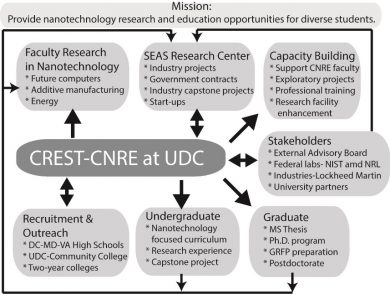
The goal is to establish the Center for Nanotechnology Research and Education (CNRE) at UDC. Our mission is to use UDC faculty’s core expertise in nanotechnology to establish a nationally recognized center of excellence to support UDC’s goals:
- to become a research-active institution that supports undergraduates research, masters and doctoral level research, benefiting students primarily from underrepresented populations;
- to support UDC’s new faculty cohort performing nanotechnology research in areas such as nanoscale electronics, metal additive manufacturing, and energy systems;
- to advance engineering curriculum by integrating multidisciplinary nanotechnology education and hands-on laboratory experience in graduate, undergraduate, and high school courses to attract, train, and retain students, focusing on underrepresented groups, for STEM workforce; and
- to strengthen UDC’s ongoing collaborations and international research partnerships with NIST, NRL, KCNSC,ORL and institutions.
Broader impact
CNRE’s research will produce new knowledge in the high-demand areas. UDC's School of Engineering will advance the newly founded research center to provide nanotechnology resources and faculty skills to solve the industry’s technological problems. CNRE will also serve as an attractive facility and resource to prospective new faculty researchers. CNRE will gain national and international significance, developing partnerships and collaborations that will benefit our faculty and students, who will be provided with opportunities to explore new ideas. The CNRE team will develop courses that integrate nanotechnology into undergraduate and graduate programs. CNRE will also engage counselors from STEM-oriented high schools as advisors for recruitment and promotion. CNRE will promote nanotechnology education for a global audience through a website and by posting videos and seminars on a YouTube channel.
 |
 |
|
|
 |
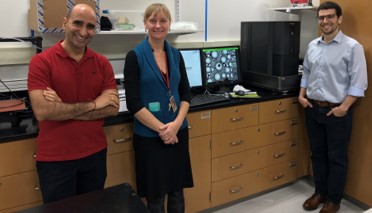
Center for Nanotechnology Research and Education
Contact Us
Director
Dr. Pawan Tyagi
ptyagi@udc.edu
202.274.6601