Skip To Translation Selection Skip To Top Navigation Skip To Content Skip To Footer
Emergency Alert
UDC Operating Remotely on Friday, Jan. 30

The University of the District of Columbia’s academic and administrative offices will conduct business remotely on Friday, Jan. 30. All on-campus activities, including athletic-related activities, are cancelled.

Campuses will reopen on Monday, Feb. 2.

Staff: Contact your immediate supervisor with questions or for further instruction regarding remote work expectations. 

Faculty: Reach out to your immediate supervisor and/or the dean for questions and further instruction regarding the transition to emergency remote instruction (ERI).  The Center for the Advancement of Learning (CAL) is available to support faculty with instructional continuity, including support for Blackboard, Zoom, Webex and other teaching and learning technologies. 

CAL Faculty Support Resources

calhelpdesk@udc.edu 
Virtual Office Hours
Consultation Request Form

For learning technology tools and on-demand faculty resources, please visit CAL’s website.

Students: Due to inclement weather, the university will be closed to face-to-face operations. Instruction will be moved to emergency remote, including synchronous and asynchronous methods. Certain laboratory, clinical, and other hands-on classes for which in-person instruction is a requirement may necessitate a make-up lesson, but every effort will be made to pursue virtual learning to the extent possible. Where synchronous virtual instruction is intended, published class meeting times must be observed so that students’ schedules are not disrupted.

The safety and security of our students, faculty, staff, and the broader community remain our top priority. We will continue to provide updates regarding the status of the university’s academic and administrative offices as conditions change.

Please continue to check our website and social media channels for the latest information.

If you have any safety concerns, contact OPSEM at 202-274-5050. For all immediate emergencies, call 911.

Thank you for your continued dedication to our students and to UDC’s mission. 

BioMed Students

NIH-C06-Specialized-Technological-Center-For-Assistive-Rehabilitation-Research-Star

NIH-C06-Specialized-Technological-Center-For-Assistive-Rehabilitation-Research-Star

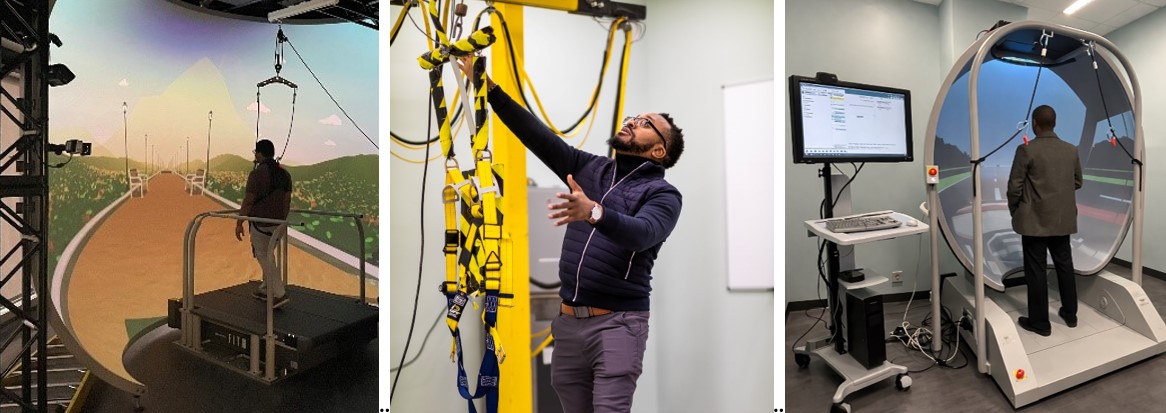
Through our National Institutes of Health (NIH) C06 grant, a Specialized Technological Center for Assistive Rehabilitation Research (STAR), will position UDC to serve as a national hub, beacon, and gold-standard, “STAR” facility for rehabilitation-related research focused on aging and impaired populations.

MISSION

The new, upcoming STAR Center will create an environment that fosters research-driven specialized technological services focused on biomechanical and rehabilitation engineering-related research, a critical need. The STAR Center will bring together students, researchers, faculty and staff within UDC but also the surrounding consortium of universities, institutes, and hospitals. A goal of the Center is to serve, determine solutions, and obtain new scientific knowledge on a wide array of populations including aging individuals, veterans, amputees, survivors of stroke, Parkinson’s patients, and other impaired and unimpaired populations.

HISTORY

A biomechanical and rehabilitation engineering research Center, consisting of multiple biomedical engineering research laboratories with large scale state-of-the-art fixed-equipment, was first conceived and conceptualized by Dr. Lara Thompson in 2018. This new facility is being designed and constructed via awarded NIH C06 funds granted to UDC in Fall 2020. Funds are being used to expand, renovate, and equip new multi-researcher biomedical research laboratories focused on: a) Gait & Balance; b) Assistive Robotics for Rehabilitation; c) Biomechanics; d) Virtual Reality Rehabilitation.

Gait & Balance
-In fall-prone elderly, survivors of stroke, Parkinson’s patients, veterans & amputees
-In un-impaired individuals (such as athletes)
Biomechanics
-Imaging-related research (tied to injury-biomechanics)
-Materials-related research tied to implantable devices, orthopedics, and biomaterials
Assistive Robotics for Rehabilitation
-Fall-prone elderly, survivors of stroke, veterans & amputees (assistive robotics for gait & balance)
-For amputees or paralyzed individuals (brain-to-machine interface using EEG and robotics)
-Post-traumatic stress disorder (PTSD) in veterans & teaching children with autism (utilizing robotics for behavioral/psychology-related studies)
Virtual Reality Rehabilitation
-Fall-prone elderly, survivors of stroke, veterans & amputees (locomotion, sensorimotor integration)
-Older individuals & survivors of stroke
-People with disabilities (e.g., autism)
-Veterans (e.g., with post traumatic stress disorder (PTSD) or traumatic brain injury (TBI) 


This STAR Center builds upon the Center for Biomechanical and Rehabilitation Engineering (CBRE) that was initiated in Summer 2015.

DIRECTOR

Dr. Lara Thompson
Lara.thompson@udc.edu

Back to Top
Take The Next Steps, Today!