Skip To Translation Selection Skip To Top Navigation Skip To Content Skip To Footer
Emergency Alert
UDC Operating Remotely on Friday, Jan. 30

The University of the District of Columbia’s academic and administrative offices will conduct business remotely on Friday, Jan. 30. All on-campus activities, including athletic-related activities, are cancelled.

Campuses will reopen on Monday, Feb. 2.

Staff: Contact your immediate supervisor with questions or for further instruction regarding remote work expectations. 

Faculty: Reach out to your immediate supervisor and/or the dean for questions and further instruction regarding the transition to emergency remote instruction (ERI).  The Center for the Advancement of Learning (CAL) is available to support faculty with instructional continuity, including support for Blackboard, Zoom, Webex and other teaching and learning technologies. 

CAL Faculty Support Resources

calhelpdesk@udc.edu 
Virtual Office Hours
Consultation Request Form

For learning technology tools and on-demand faculty resources, please visit CAL’s website.

Students: Due to inclement weather, the university will be closed to face-to-face operations. Instruction will be moved to emergency remote, including synchronous and asynchronous methods. Certain laboratory, clinical, and other hands-on classes for which in-person instruction is a requirement may necessitate a make-up lesson, but every effort will be made to pursue virtual learning to the extent possible. Where synchronous virtual instruction is intended, published class meeting times must be observed so that students’ schedules are not disrupted.

The safety and security of our students, faculty, staff, and the broader community remain our top priority. We will continue to provide updates regarding the status of the university’s academic and administrative offices as conditions change.

Please continue to check our website and social media channels for the latest information.

If you have any safety concerns, contact OPSEM at 202-274-5050. For all immediate emergencies, call 911.

Thank you for your continued dedication to our students and to UDC’s mission. 

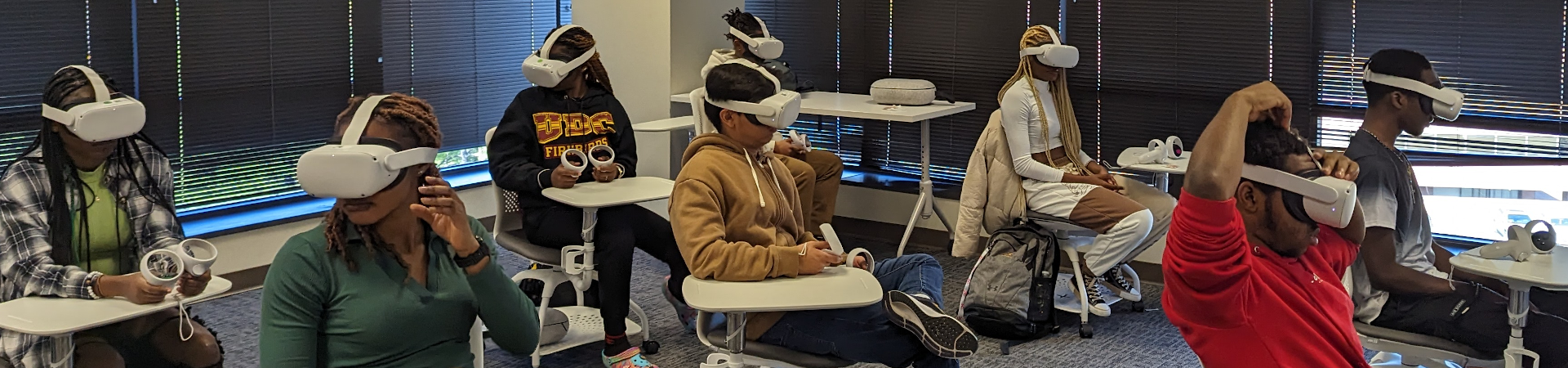
A classroom of students sitting at desks wearing virtual reality headsets.

Virtual Reality

Virtual Reality at UDC

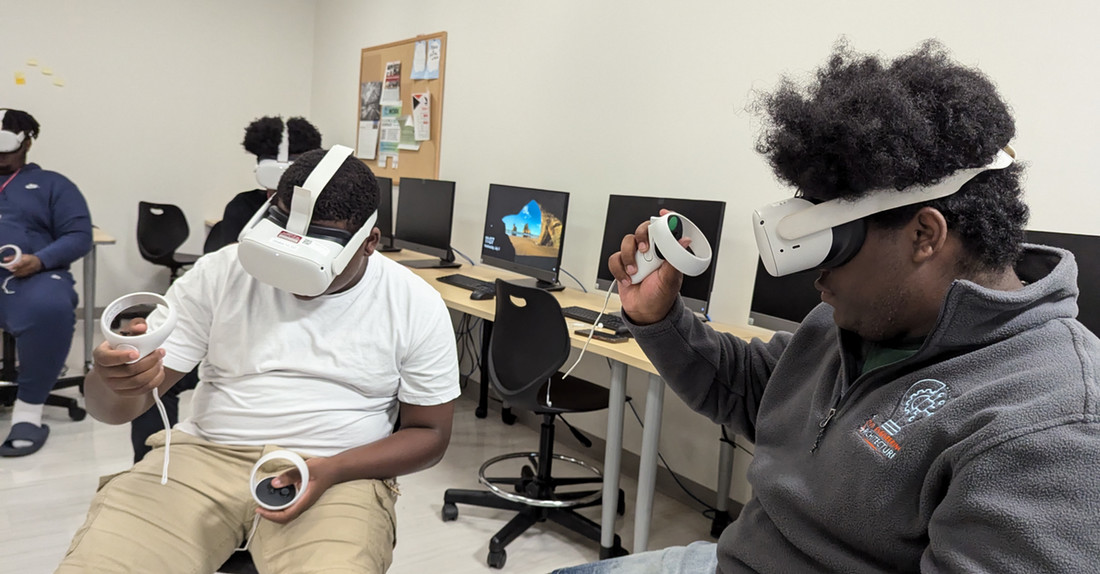
At UDC, we recognize that virtual reality (VR) holds great potential to reimagine traditional teaching methods and engage learners in innovative ways, such as: 

  1. Simulation-based and Experiential Learning: VR allows learners to actively participate in simulated experiences and realistic scenarios relevant to their field of study. For example, nursing students can interact with digital versions of human anatomy, psychology students can engage in counseling simulations, or business students can go through virtual interviews. In a digital world, we can create a controlled environment for students to develop skills, decision-making abilities, and critical thinking.

  2. Visualization: VR can help students to undesrtand complex and abstract concepts by creating 3-D models that can be viewed from every angle. For instance, students can explore mathematical models, molecular structures, or anatomy through interactive VR simulations. 

  3. Immersive Learning Experiences: VR enables faculty to provide immersive and realistic learning environments that deliver experiences to their learners that would otherwise be inaccessible from inside the classroom. Through VR, students can see through the eyes of people from different background, virtually walk or fly through places thousands of miles away, and see art and music in ways that are impossible in the real world. 

  4. Accessibility and Inclusivity: Virtual reality can overcome accessibility barriers by offering inclusive educational experiences. Students with physical disabilities can participate in virtual field trips, lab experiments, or hands-on learning activities that might otherwise be inaccessible to them in a traditional experience.

  5. Cultural and Global Understanding: Virtual reality enhances cultural competence and global awareness by enabling students to virtually explore different cultures, historical eras, or geographic areas. Through VR, students can visit museums, travel to distant regions, or interact with diverse communities, fostering empathy, intercultural understanding, and expanding their worldviews. 
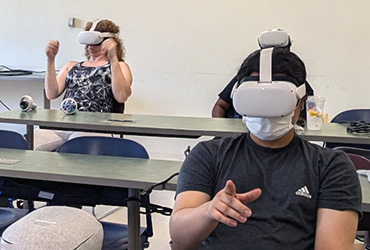
Virtual Reality at UDC

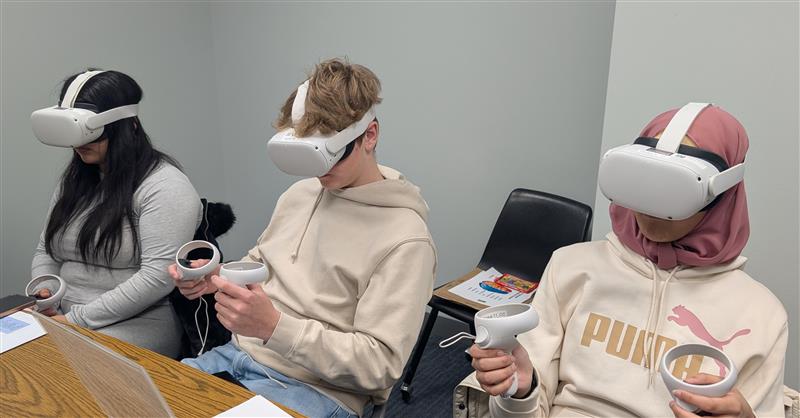
2 students in VR headsets in a classroom

Accessing Virtual Reality

With Virtual Reality (VR) experiences, learners can see what they're learning from brand new perspectives that would be otherwise impossible. CAL can provide training for faculty and workshops for classrooms and events that guide you through the use of the headset, its applications, and provide guiding questions and discussion on the future of VR and immersive technologies. Sign up for a conusltaiton with a member of our team and we can discuss how VR can enhance your teaching.

Sign up for a CAL Consultation
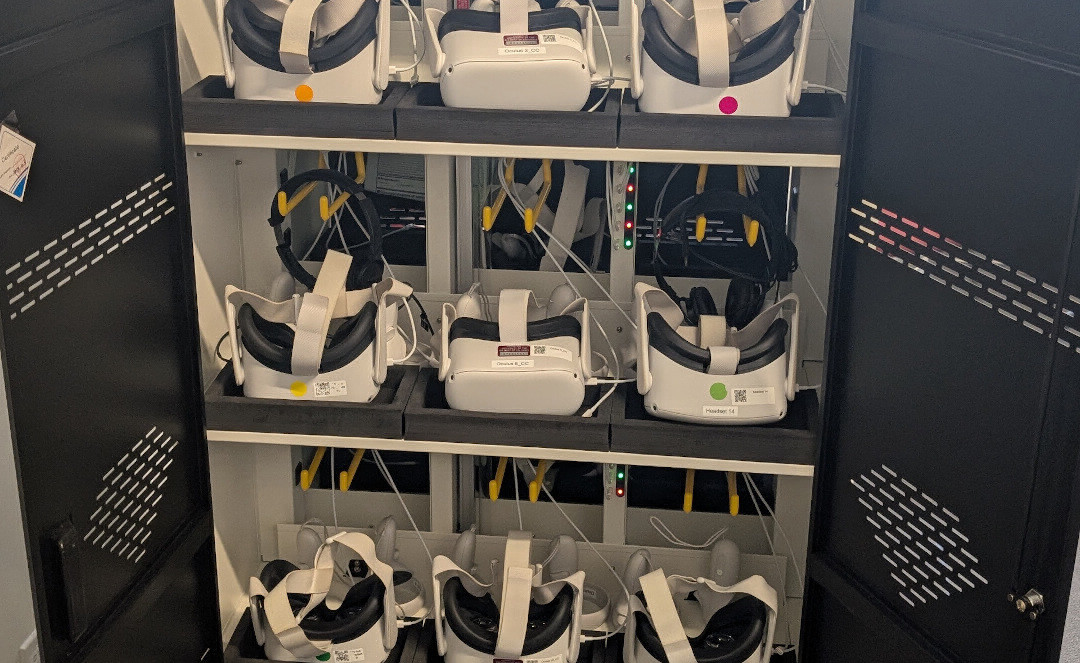
Cabinet of VR headsets with some headphones

VR Equipment

For our CAL-facilitated VR experiences, we have 45 Meta Quest 2 headsets that can be brought to the classroom without the need for extra cables or computers. We have additional access to Meta Quest 3, Meta Quest Pro, and HTC Vive Focus 3 headsets. These are stored in our state-of-the-art charging cabinets equipped with UV-sanitization lights to ensure the safety of our faculty and learners. We also have optional headphones and spacers to assist with eye glasses for all headsets.

Faculty can request a loaner VR headset to prepare for workshops, classes, or to conduct research. 360° GoPro cameras can also be loaned for projects to create content viewable on the VR headsets. Please contact calhelpdesk@udc.edu or fill out our consultation request for more details.

Sign up for a CAL Consultation
Back to Top
Take The Next Steps, Today!